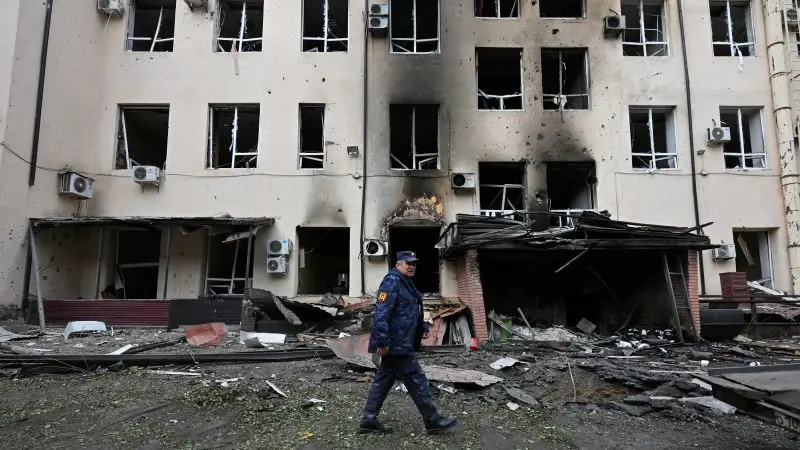
 An official walks past a building damaged by an attack in a Russian-controlled part of Ukraine, which local Russian-installed officials called a Ukrainian drone strike, on October 20, 2026.
It’s like two theatrical performances unfolding side by side, before an audience of one.
The peace process surrounding Russia’s invasion of Ukraine has reached a remarkable impasse.
On one stage, European allies and Kyiv are scrambling to turn US demands and threats into something resembling a plan that might satisfy President Donald Trump. On the other, the Kremlin has its own show: envoy Kirill Dmitriev offers business opportunities designed to appeal to a mercantile US president, draw him further into Moscow’s orbit and allow Russia’s crawling frontline advance to proceed. Trump’s envoys, Steve Witkoff and Jared Kushner, flit between the two productions. Yet the two plots remain separate and contemptuous of each other, with no denouement in sight.
When Trump speaks of a deal with Russia, one fact outweighs all others: Moscow’s idea of peace is basically victory. The Kremlin has been blunt about its demands, even in their least maximalist form. Russian President Vladimir Putin wants Ukraine to surrender the Donbas without further fighting. He has also long entertained Ukraine’s demilitarization, a pledge never to join NATO and a change of leadership in Kyiv — all impractical or impossible in wartime. Russia’s pragmatist-in-chief has therefore settled on the Donbas as an attainable negotiating goal, while pressure grows on Kyiv to concede.
 Video Ad Feedback
White House envoy Witkoff meets with Zelensky amid growing rift
2:27
• Source:
CNN
 White House envoy Witkoff meets with Zelensky amid growing rift
2:27
Why does Zelensky not simply yield? Reasons to do so grow as what remains of the Donbas becomes less habitable by the day. Russian drones stalk Kramatorsk, the largest population center, hunting civilians around the clock. Sloviansk, Dobropillia and Kostyantynivka are either ruins or targets for Russian glide bombs: places of great military importance, but little remaining civilian life.
Yet the clearest case for why Ukraine cannot simply abandon the Donbas came from none other than Trump’s National security adviser, and possible successor, Marco Rubio. Russia controls all but 11% of the Donetsk region, while Ukraine describes the remainder as the “defensive line that they’ve embedded themselves in,” he said, in an interview with Breitbart News. “They argue, and military strategists say is true, that it is the last defensible line… From there, it’s just a straight shot into Kyiv.” He added that Russia is not really advancing and has therefore switched to “applying extraordinary pain on the people of Ukraine through drone strikes, through ballistic missile strikes, trying to destroy their energy infrastructure, their electricity.” Ukraine, in turn, is striking Russian refineries.
 Ukraine's President Volodymyr Zelensky hugs US envoy Steve Witkoff during a meeting with Norway's Prime Minister Jonas Gahr Store and Finnish President Alexander Stubb in Oslo, Norway, on October 20, 2026.
He acknowledged Kushner and Witkoff’s efforts, but ultimately concluded: “We’d like the war to end, but ultimately we also have other priorities around the world we’re focused on as well.”
Rubio spent 45 minutes on the phone with Zelensky on Tuesday, suggesting he may be more invested in the outcome than this closing remark implies. But his lowered expectations reflect the reality of these two separate onstage peace performances. Ukraine wants to survive; Russia wants to win, and still believes it can.
If one of the sounder minds in the White House sees peace as a long shot at best, what did the past 10 days of US-Ukrainian fallout achieve? Did it get Trump any closer to the deal he says he wants?
Trump has offered a striking array of pro-Russian incentives to draw Moscow towards a peace whose terms he has yet to define. It looks like pressure for its own sake — and to Putin’s immediate advantage.
The list of Trump gifts to Moscow is extensive: a sudden diesel deal likely to throw billions into Putin’s war chest; an energy ceasefire (unilaterally announced by Trump and apparently unknown to either side), that slowed Ukrainian strikes on Russian refineries for several days. There were also restrictions on vital Starlink technology that affected Ukraine’s defensive and offensive operations; limits on intelligence sharing that left Ukraine without warning of ballistic missile attacks for at least several nights; and repeated calls for Zelensky to leave office. Add to that the monthslong collapse of US financial support for Ukraine, with Europe now paying for military aid. If Putin could write US policy, it might look much like this.
Speaking in a news conference in Oslo after meeting with Witkoff in person and Kushner virtually, Zelensky said he hoped for a positive word from Rubio soon on the US-made Patriot air defense system and Starlink, while also saying that his country was “thankful that intelligence sharing” with the United States “now works.” Witkoff heads to Russia tomorrow and the nature of what he will present to Putin remains unclear.
Why now? The political damage Trump is inflicting on himself and his Republican colleagues ahead of the midterms is palpable. Some are struggling to distance themselves from this profoundly anti-American barrage of pro-Russian policies. Equally striking is how unsustainable or impractical many of these measures are. The diesel deal will not lower US pump prices quickly and European restrictions, will probably limit how much cash it can deliver to Putin. The energy ceasefire was brief, absurd, and further undermined Trump’s credibility. Restrictions to Starlink, Starshield, the military-grade version of Starlink controlled by the US government, and intelligence sharing appear to come and go, leaving Ukrainian troops in the lurch, while Rubio echoes Trump’s denial that any such limits ever existed.
This flurry of baffling activity makes sense only when seen through the US political prism. It is addressing the world after the midterm elections.
Zelensky has dispensed with the canard that pandering to Trump works. Ukraine is emotionally more adjusted to the idea of losing US support and going it alone, aware that survival is preferable to friendship with a fickle US. Europe knows there is a limited window now left in which Trump can do damage, and that whatever comes next is better. Even if it is more of the same, at least Europe and Ukraine will have had longer to prepare to go it alone.
Most troubling is Trump’s timing and thinking. He is only doing damage to his party and legacy. But with Republicans still in control of the House and Senate, and 2028’s race to succeed him not yet begun in earnest, perhaps he sees this as his last unbridled moment to express in practical ways his sympathy to someone apparently oddly important to him, as a US president: Vladimir Putin.
See all topics Email Link Copied!