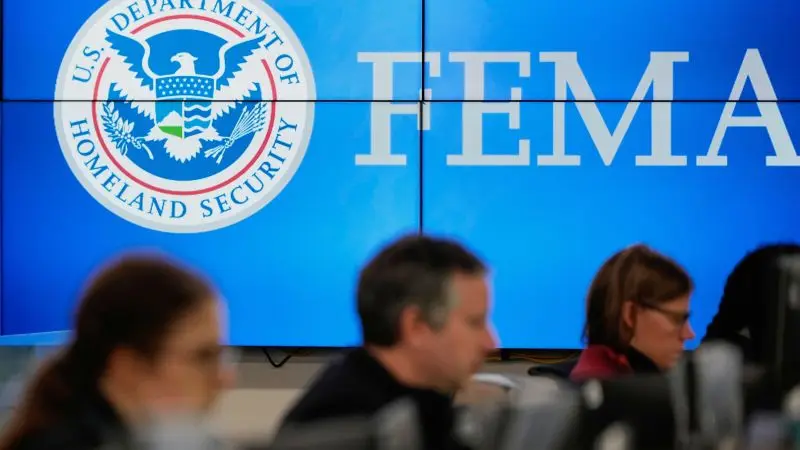
 People work at the Federal Emergency Management Agency headquarters in Washington on January 24, 2026.
The Federal Emergency Management Agency sought to acquire two executive jets upgraded with military technology for agency leaders even as the Department of Homeland Security, which oversees FEMA, has struggled to put multiple planes it has purchased to use.
FEMA’s plan to lease two jets with advanced capabilities like laser mapping was quickly withdrawn just hours after a public notice soliciting contracts for them was posted on a government contract website last week.
The proposal had called for planes that would be available 24/7 to support rapid response but would be primarily used to transport FEMA Administrator Cameron Hamilton and other senior officials during disasters or regular travel, sources told CNN.
FEMA already funds various types of aerial assets such as search-and-rescue teams and often uses military planes for logistics.
Hamilton’s team solicited the jets without approval from DHS leadership, according to three sources who spoke with CNN on condition of anonymity. It quickly drew scrutiny from other department leaders, partly due to controversy over the agency’s aircraft purchases.
“It’s probably not the time to be soliciting planes at DHS,” one of the sources said.
DHS has been accumulating aircraft faster than it is able to put them to use, according to flight records and aviation sources, at the expense of taxpayers. The latest FEMA plan was drawn up as DHS has already spent hundreds of millions on aviation contracts and aircraft, including a fleet of 10 planes the agency said was intended for the department to operate its own mini deportation airline.
But many of those planes have remained parked at a maintenance hangar in Louisiana, and there are no plans to use most of them for deportation operations, CNN has learned.
In recent weeks, two of DHS’ aircraft were moved to a different maintenance facility, in Greensboro, North Carolina, while one of the planes — a Gulfstream jet — has been used to transport administration officials, according to flight-tracking data and members of Congress.
These flights have been used by the likes of FBI Director Kash Patel and members of the first family, according to Democratic members of Congress.
One plane was used for a trip from Washington, DC, to Dallas, on the same dates as the Republican midterm convention in that city last month, the flight-tracking data shows, though it is unclear who was onboard.
Soon after the FEMA leasing plan emerged, DHS leaders quickly demanded agency leaders slam the brakes, the sources said. A spokesperson for DHS told CNN: “This was an unauthorized post by an unauthorized individual and disciplinary action will be taken.”
The administration vowed last year to eliminate FEMA, portraying it as wasteful and unnecessary and pushing states to shoulder more responsibility for disaster response and recovery.
FEMA has not responded to CNN’s request for comment.
Grounded planes
The FEMA procurement plan drew scrutiny from DHS leaders who demanded Hamilton’s team reverse course, sources said. Public records show the contract solicitation has been taken down from a government contracting website.
The proposal is the latest instance of President Donald Trump’s DHS pursuing taxpayer-funded aircraft while the administration pledges to cut federal spending and eliminate waste.
Since 2025, DHS has spent heavily on both aviation assets and contracts tied to the Trump administration’s unprecedented deportation effort.
The agency spent $464.5 million to purchase eight Boeing 737s and two Gulfstream G-650 jets as part of a plan to fly its own deportation flights, something the agency for decades has relied on charter airline operators for. In May, some critics told CNN the agency’s purchase price for its fleet was well above the market value.
 A Department of Homeland Security aircraft, recently acquired for deportation flights, is seen at Dulles International Airport in Virginia on March 6, 2026. This plane is part of the agency’s new fleet for deportations.
While those planes remain largely unused, the agency also spent $885.6 million in the last year for contracted charter airline services for Immigration and Customs Enforcement flights.
And now, the agency has awarded a contract worth $380 million to Eastern Air Express — a charter airline — to fly and maintain the “government furnished aircraft,” referring to planes in the DHS fleet that have not carried out a single deportation flight since they were purchased between late 2025 to early 2026.
Federal contracting records show that agreement began in August 2026 and runs through February 2028. It’s unclear what the cost per flight hour the contract calls for or what other aspects of the operations Eastern Air Express will be responsible for.
Neither Eastern Air Express CEO Jeff Conry nor DHS responded to CNN’s request for comment regarding the contract.
Taken together, DHS’ costs for its fleet and contracts with charter airlines for ICE flights exceed $1.6 billion.
But, DHS has told lawmakers privately it is expecting to use only three of the seven Boeing 737 aircraft for deportations. The others would be left for members of Congress and other government officials, according to a congressional source with knowledge of the matter — a departure from the reasoning given for buying the planes, and a significant scaling back on the number of planes the agency initially planned to use for deportations.
There is skepticism among some lawmakers about the plans for these planes and whether they will be used for shuttling members of Congress.
“No one asked for ICE planes for CODELs,” the congressional source noted, referring to an acronym for official travel taken by lawmakers. Transport for these trips usually relies on commercial aircraft or a charter, but “never via ICE planes,” the person said.
“They bought these planes, they paid a ridiculous price for them, they’re trying to find a solution for it, but no one knows how it’s going to work,” one aviation insider familiar with the governments charter operations told CNN.
‘We just could not find a true cost-benefit’
After DHS halted FEMA’s bid for the jets last week, Hamilton sent a memo to his agency reiterating its role to “support, coordinate and supplement” local efforts and “not replace” these during and after disasters, saying it should “apply sound judgment, fiscal responsibility, and accountability when directing readiness resources.”
FEMA leaders have traditionally relied on aircraft from the Federal Aviation Administration, Air Force or Coast Guard to reach disaster zones, while flying commercial for routine travel.
The agency has considered getting a jet of its own before. During the Biden administration, then-FEMA Administrator Deanne Criswell briefly explored buying a plane for travel during disasters, but the idea never got far.
“We just could not find a true cost-benefit,” Criswell told CNN recently. “The purchase of two dedicated jets is an unnecessary expense and a poor use of taxpayer dollars.”
Hamilton served as FEMA’s acting administrator at the beginning of Trump’s term until then-DHS Secretary Kristi Noem and her chief adviser, Corey Lewandowski, abruptly removed him after he told Congress he did not believe the agency should be eliminated.
 Cameron Hamilton speaks at a confirmation hearing to be the administrator for the Federal Emergency Management Agency in Washington on June 17, 2026.
During their tenure, Noem and Lewandowski repeatedly assailed FEMA and took steps that slashed the agency’s workforce, battered morale and weakened federal disaster readiness, CNN has reported.
After ousting Noem, Trump nominated Hamilton to return as the agency’s permanent leader, and the Senate confirmed him in August. Sources familiar with Trump’s decision said Hamilton was brought back largely to steady the agency and keep it out of damaging headlines. Since returning, Hamilton has tried to reorganize parts of FEMA but has taken few major steps to advance the administration’s effort to shrink its reach.
Meanwhile, the administration has not confronted a catastrophe on the scale that has tested past presidencies. Career FEMA leaders — including many who have left amid the administration’s cuts — worry the agency may no longer have the people or capacity it will need when that test comes.
See all topics Email Link Copied!