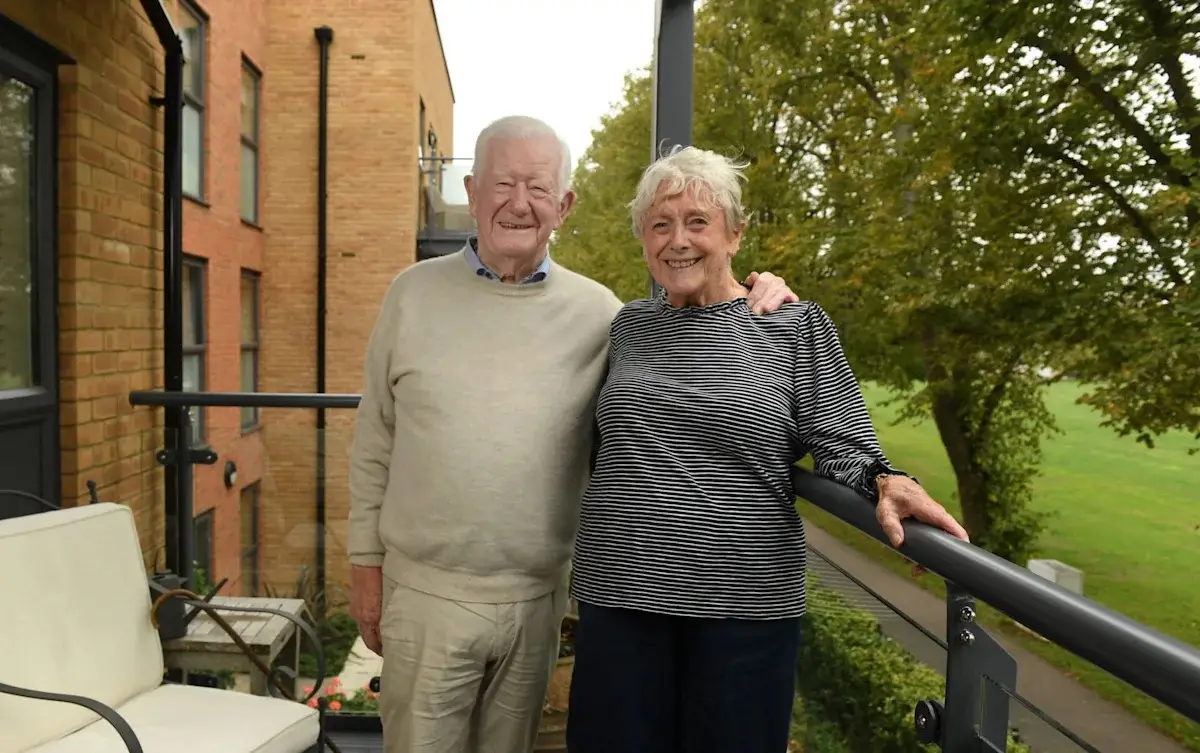

When deciding to move into a retirement village, Brian and Margaret Raincock deferred to their three children.
They felt it was their duty to consult the people who would eventually sell the property after they died.
Weighing heavily on their minds was the fact that these homes are notoriously hard to sell, partly because service charges still accrue on vacant properties.
"Retirement homes are a fantastic asset, but the issue is the resale problem and the service charges once they are left to your children," says 89-year-old Brian.
So they held a "family conference" and decided that buying wasn't the right move. Instead, Brian and Margaret, 88, decided to sell their family home in Chichester in 2025 and rent a nearby McCarthy & Stone flat.
Their story captures a growing trend among retirees, who are increasingly renting rather than buying retirement flats.
Inquiries for rental properties at McCarthy & Stone developments increased by 43pc year on year between January and August. So far this financial year, nearly one third of their completions have been rentals.
Retirement homes are leasehold properties with age restrictions, usually limited to people aged 65 or older.
The Telegraph has heard horror stories from readers who have inherited properties from a variety of providers. They couldn't sell them for years, all the while paying extortionate service charges.
"Given the age at which people tend to downsize and the stamp duty costs of buying a downsizer property, renting has become an increasingly attractive option for retirees," said Lucian Cook, of estate agency Savills.
"That is reinforced by the flexibility, which renting can provide as care needs change in later life."
So, is renting the answer to Britain's downsizing crisis?
'A game changer'
For many aged 65 or older, retirement villages provide safe, comfortable homes with a sense of community.
The average cost of renting, including service charges, at a McCarthy & Stone development is £2,593. This includes housing with care services, which will push the average up.
Brian thinks it's the perfect solution. "Considering we have somewhat of a housing crisis on our hands, the flexibility of renting in retirement villages is a real game changer," he says.
Nick Sanderson, founder of Audley and Mayfield retirement villages, says this type of tenure could have a major impact if it becomes more common.
"It could fundamentally change the downsizing landscape, giving older people greater choice and potentially encouraging more to release equity tied up in their existing homes without having to commit to another property purchase," he adds.
When rental apartments at one of their developments at Nightingale Place in Clapham, London, went on the market, they were "snapped up at pace", he says, and quicker than the properties for sale.
"The significant costs associated with purchasing a new home, particularly stamp duty and other moving costs, can make buying expensive, whereas renting can provide a more affordable and lower-commitment way to move into a home that better suits their changing needs."
'It's not cheap'
But renting into retirement is expensive, as these costs come out of a fixed pension income. How do the Raincocks cope?
"It's not cheap," Brian admits. Monthly rent at his development starts at £3,495.
He candidly says he doesn't have "a huge time to go", meaning "you can arrange your finances accordingly". He says it's manageable as long as you budget.
This setup inevitably limits access to wealthier retirees, David Fell of Hamptons highlights. "This inevitably raises the risk of displacement or insolvency if a tenant outlives their savings and rental costs exceed local housing allowance limits."

Dennis Reed represents senior citizens at charity Silver Voices. He says that in most areas, finding "a local, accessible flat for rent at an affordable price is a big ask".
But for the Raincocks, who feel they can keep up the payments, it's worth it, and they have built a real community.
Residents organise regular events: "We have a Cheltenham day, a Trooping of the Colour day, films on a Monday and Thursday, evening meals," Brian says.

And it's not just residents who seem to benefit from this system. A 2019 report by a group of developers, including Churchill and McCarthy & Stone, found that each person living in a retirement home "enjoys a reduced risk of health challenges", which can save the NHS and social care services some £3,500 a year.
'I don't have a care in the world'
David Pegg moved into Roman Court in Middlewich, a McCarthy & Stone development, in October last year.
Like the Raincocks, he decided to rent, and his children were a major consideration.
His family is blended, meaning he will leave his estate to both his late wife's children and his own. He didn't want to burden the two families with the hassle of navigating a resale.
"It's going to be difficult to sell it, because you're selling to a very small pool of people," Pegg says.
That's a problem Stephen Crowhurst knows too well. He cut the asking price of his late mother's McCarthy & Stone flat in half, to £100,000. Despite this, the property continues to languish on the market.
Retirees seem reluctant to buy second-hand retirement flats, even with a drastic price cut.
For occupants such as Pegg, moving into a turn-key property with a built-in community is priceless, especially since he lives alone.
He met three people in 18 months in his previous flat: "Being an old bloke moving to a new town, it's very difficult to make friends.
"I tried doing all sorts of things, exercise classes, bowling, volunteering at a community cafe and all sorts. But I still used to spend an awful lot of time on my own."
That is far from the situation now.
"Now, if I want to be on my own, I can come into my apartment, and if I want some company, I can go down to the lounge, and within the space of five minutes, I guarantee somebody will be there," he says.
From quizzes to coffee mornings, and fish and chips to game afternoons, Pegg has the same kind of social life as the Raincocks.
Like them, he agrees it is expensive, but he thinks he's getting good value.
"If something goes wrong in this apartment. I tell the apartment manager, and she sends somebody to fix it. And I don't have a care in the world, which is not a bad way to be when you're 77," he says.
The service charges are included in this rent: "It is eye-wateringly expensive, but there's nowhere else I would have a lifestyle like this."
Pegg has a pension from 32 years of work for British Telecom (now BT), as well as the state pension. He also received a substantial windfall from selling a bungalow he had previously rented out.
As a result, he can afford the rent.
"People sometimes consider rent to be dead money, and so don't like this idea at all. But I think you need to think about more than that," he says.
"It's going to cost you to live however you do it. But this way, you're not leaving your family with a problem."
Matthew Pratt, of McCarthy & Stone, said: "Our service charges – which we believe deliver exceptional value – are linked to property ownership, not occupancy, just as in the wider housing market, and the vast majority of them are passed on at cost – we don't add any mark-up.
"We work hard to support customers while they are selling their apartments, and this can include renting out their property to cover service charges if they wish."
Terms and Privacy Policy Privacy & Cookie Settings More Info